
Introduction
The bat and ball are two of the most recognizable pieces of equipment in cricket. Together, they shape the essence of an undertaking finished and located with the useful resource of hundreds of heaps of people around the arena. Cricket is a bat-and-ball sport wherein one team bats to scoreruns atwhilehe opposing team bowls and fields to restrict scoring and dismiss batters. A favored cricket team includes 11 game enthusiasts, and the game is carried out on a spherical field with a wicket at each end. Although the primary concept of cricket is easy, the game consists of unique rules, situations, strategies, equipment specifications, and scoring guidelines. Understanding the features of the bat and ball is consequently a useful place to begin for everyone who desires to observe cricket.
What Is a Bat and Ball Game?
A bat and ball game is a game wherein game enthusiasts use a bat or similar striking implement to hit a ball. Cricket is one of the most highly regarded examples of this kind of pastime. Other bat-and-ball sports activities encompass baseball and softball, even though their rules, equipment, and gambling regions are very different. In cricket, the batter uses a flat-faced bat to hit a ball bowled by the bowler. The batter can score runs by running on foot between the wickets or by hitting the ball to the boundary. A boundary reached after the ball touches the ground normally scores 4 runs, whilst a ball that reaches the boundary without bouncing ranks 6runs. The mixture of bat, ball and wicket creates the critical contest of cricket. The batter attempts to gain runs, at the equal time because the bowler attempts to overcome the bat, limit scoring or disregard the batter.
What Is a Cricket Bat?
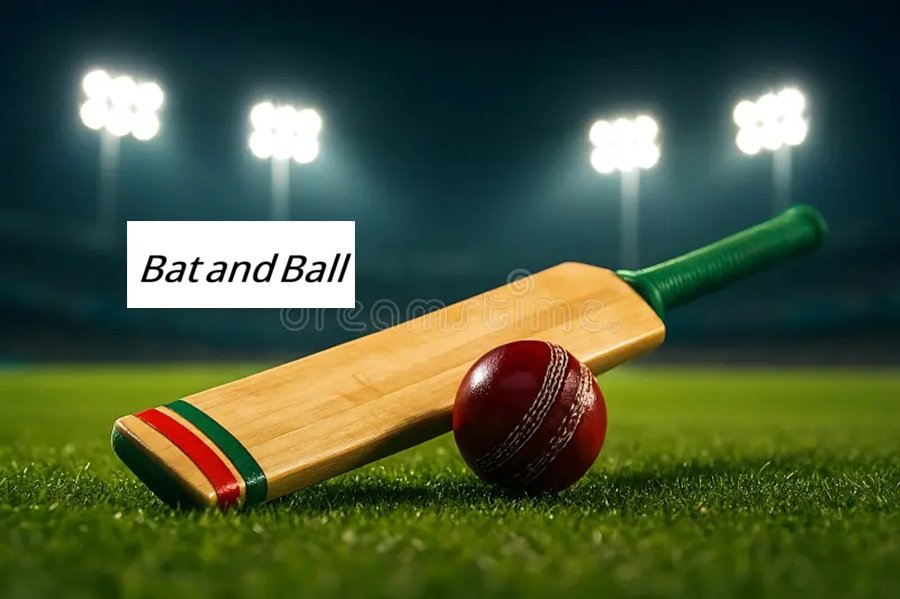
A cricket bat is a unique wooden piece of equipment utilized by the batter to strike the cricket ball. It generally consists of a long handle and a much wider blade. Traditional cricket bats are made from willow. Two commonly mentioned sorts are English willow and Kashmir willow. The preference amongst them can depend upon a participant’s experience, choice of variety, gambling frequency, favored bat weight, and style of play. The essential parts of a cricket bat include the handle, grip, shoulder, blade, face, lower edge, and edges. A flat face permits the batter to control the ball and play unique shots. The edges and candy spot additionally have an effect on how the ball behaves even when struck.
Main Parts of a Cricket Bat
| Bat Part | Main Function |
|---|---|
| Handle | Helps the batter hold and control the bat |
| Grip | Provides comfort and reduces slipping |
| Blade | Main striking portion of the bat |
| Face | Flat surface used to hit the ball |
| Edge | Side portion of the blade |
| Shoulder | Connects the blade to the handle |
| Toe | Bottom section of the bat |
| Sweet Spot | Area designed to provide effective ball striking |
The Laws of Cricket specify limits and necessities for bat design. For example, the bat is problem to maximum dimensions, and the blade need to be crafted from wood.
What Is a Cricket Ball?
A cricket ball is the object delivered by the bowler toward the batter. It is designed to face as much as repeated impacts from the bat and talk to with the gambling floor.Traditional cricket balls have a cork-based totally simply centre surrounded via way of layers of material and covered with leather-primarily based. The ball includes an outstanding seam, which could have an effect on its movement through the air and after pitching. Cricket balls can fluctuate depending on the format and game situations. Red balls are historically related to Test cricket, while white balls are substantially utilized in confined-overs cricket. Pink balls are also used in day-night cricket.
Bat and Ball: Important Information at a Glance
| Feature | Cricket Bat | Cricket Ball |
|---|---|---|
| Primary purpose | Hit the ball | Delivered toward the batter |
| Common material | Willow wood | Leather-covered construction with cork centre |
| Used by | Batter | Bowler and fielding team |
| Main role | Scoring and defending | Bowling, fielding and dismissals |
| Key characteristics | Weight, balance, shape and grip | Weight, seam, condition and movement |
| Common formats | Test, ODI, T20 and recreational cricket | Test, ODI, T20 and recreational cricket |
How Does Bat and Ball Cricket Work?
The crucial aspect of cricket consists of teams taking turns to bat and difficulty. The batting issue attempts to score as many runs as possible. Two batters are commonly on the sphere on the equal time. One is the striker, who faces the delivery, on the identical time as the alternative is the non-striker. The fielding team has a bowler deliver the ball and specific players located around the sphere. The bowler tries to disregard the batter or save you runs. Once an innings or unique batting duration is finished, the organizations trade roles. The unique form is predicated upon the layout. Test matches can consist of innings consistent with the format, whilst stylish ODI and T20 formats commonly contain one innings per team.
Understanding the Cricket Pitch
The crucial playing region is the cricket pitch. A full-size cricket pitch is 22 yards long. There is a wicket at each end. Each wicket consists of 3 stumps with two bails positioned on top. The bowler bowls the ball from one end toward the batter on the opposite end. The batter protects the wicket at the same time as looking to attain runs. The pitch is important due to the fact the ball can behave in any other case relying on its condition. Fast bowlers also can use pace and leap, on the same time as spin bowlers try to make the ball turn after pitching.
How Runs Are Scored With a Bat
The most important purpose of batting is to acquire runs. A batter can hit the ball into precise areas of the field, after which they run a number of runs. If every batter successfully exchanges, one run is recorded. They can run if the fielding team has not caught the ball quickly enough. A batter can also hit boundaries.
4runs: The ball reaches the boundary after touching the ground.
6runs: The batter hits the ball over the boundary without it touching the ground in the vicinity.
Runs moreover may be provided via extras, together with wides, no-balls, byes and leg byes.
Different Ways a Batter Can Be Dismissed
One of the most crucial elements of bat and ball cricket is the opposition between scoring runs and taking wickets.
A batter can be disregarded in numerous strategies. Common dismissals include:
- Bowled
- Caught
- Leg before wicket
- Run out
- Stumped
- Hit wicket
A bowler can therefore use one-of-a-kind strategies to create possibilities for dismissal. A fast delivery can limit the batter’s response time, while spin can change the course and pace of the ball after pitching.
Types of Cricket Bats
Cricket bats may be categorized in specific techniques relying on their material, size, weight and meant consumer.
English Willow Bat
English willow is commonly associated with higher-end cricket bats. It is well-known among experienced and superior game enthusiasts who want a conventional willow bat with unique everyday usual overall performance tendencies.
Kashmir Willow Bat
Kashmir willow bats are extensively used by beginners, leisure gamers, and growing cricketers. They are frequently to be had at a lower price than top charge English willow bats.
Junior Cricket Bats
Junior bats are designed for younger game enthusiasts. They are smaller and lighter than men’s or women’s bats, permitting younger cricketers to improve their technique without struggling with an unnecessarily heavy bat.
How to Choose the Right Cricket Bat
Choosing a cricket bat is not necessarily about looking for the most expensive model. The accurate bat need to in shape the participant’s age, top, strength, capacity degree and playing fashion.
Important factors consist of:
Weight: A bat needs to be lightweight. A bat this is too heavy have to make stroke play difficult and may negatively have an effect on method.
Balance: The stability determines how the bat feels while being lifted and swung.
Handle: The handle ought to provide a cushty and solid grip.
Willow: English and Kashmir willow offer unique alternatives in terms of feel, introduction, and ordinary performance tendencies.
Size: Junior game enthusiasts want as it want to be sized bats, at the equal time as individual gamers generally use big models.
A player have to ideally cope with a bat earlier than shopping for it while possible due to the reality bats with comparable specifications can experience unique inside the hands.
Types of Cricket Balls
Cricket balls can vary in line with the format and game situations.
Red Cricket Ball
The purple ball is strongly associated with conventional Test cricket. It is designed for longer durations of play and can change characteristics as the innings progresses.
White Cricket Ball
White balls are normally used in limited-overs cricket, including ODI and T20 formats. Their colour allows visibility under floodlights and in the direction of one among a type of background.
Pink Cricket Ball
Pink balls are used in day-night Test matches. Their colour is designed to maintain visibility under changing light conditions.
There are also schooling and leisure cricket balls available for workouts.
Bat and Ball Safety
Cricket includes a difficult ball visiting at possibly excessive speeds, so protective gear is important, especially for batters and wicketkeepers.
Depending on the extent of play, protective devices can consist of:
- Helmet
- Batting gloves
- Batting pads
- Abdominal protection
- Thigh guards
- Chest protection
- Arm protection
- Cricket shoes
- Wicketkeeping gloves
The appropriate defensive device depends on the participant’s function and the quantity and conditions of the game.
For youngsters and beginners, protection needs to be a subject. Players need to use it because it should be properly sized equipment and used with smooth techniques under suitable supervision.
Bat and Ball in Different Cricket Formats
Cricket is played in several formats, and the region of the bat and ball changes slightly in keeping with the duration and game situations.
| Format | Typical Structure | Batting Objective |
|---|---|---|
| Test Cricket | Multi-day match | Build large totals and manage long innings |
| ODI | 50 overs per side | Balance scoring with wickets and limited overs |
| T20 | 20 overs per side | Score quickly while managing wickets |
| Local Cricket | Varies | Depends on competition rules |
| Junior Cricket | Modified | Develop skills safely and progressively |
Test cricket places more emphasis on staying power, safety, and adapting to changing situations. T20 cricket normally calls for quick decision-making and aggressive scoring.
Batting Techniques for Beginners
A novice wants to first examine a comfortable grip and balanced stance.
The batter needs to watch the bowler intently and preserve the pinnacle regularatn the same time as on the point of play the transport.
Basic shots encompass:
Defensive shot: Used to protect the wicket and manipulate a tremendous-period shipping.
Straight drive: Played via the location in front of the batter.
Cover pressure: Played through the off-side, in front of the batter.
Pull shot: Used closer to shorter deliveries, depending on the ball’s pace and tempo.
Cut shot: Played inside the course of the off-thing in competition to the exceptionally quick or large delivery.
Beginners should recognition on timing and technique in place of simply in search of to hit each ball as hard as feasible.
Bowling Techniques
The ball is also important to the bowling issue.
Fast bowlers attempt to use tempo, swing, or seam movement. Spin bowlers depend extra closely on modifications in rotation and pace.
Bowling may be substantially divided into:
- Fast bowling
- Medium-fast bowling
- Off-spin
- Leg-spin
- Left-arm orthodox spin
- Other specialized variations
A bowler’s goal isn’t always to take a wicket. Building strain through limiting scoring opportunities can also create mistakes.
How the Bat and Ball Have Changed Cricket
The improvement of cricket equipment has changed the way the game is played. Modern bats can be carefully designed to provide particular balances and hitting developments. Protective equipment has moreover advanced appreciably compared with early cricket. Historical records show that early cricket equipment differed significantly from modern-day equipment. Earlier bats must resemble hockey sticks, whereas cutting-edge cricket makes use of a much straighter bat designed for pitched deliveries. Modern cricket consequently combines conventional factors with advances in manufacturing, protection, and sports technology.
Bat and Ball Cricket for Beginners
Someone analyzing cricket no longer wants to recognize every rule properly now.
A novice can begin by getting to know 5 simple ideas:
- Two businesses compete.
- One crew bats at the same time as the opposite bowls and fields.
- Batterrateng runs.
- Bowlers and fielders try to take wickets and save you runs.
- The group with the better rating typically wins, scenario to the right healthful tips.
Once those terms are understood, phrases which include innings, over, wicket, boundary, strike, and non-striker turn out to be much simpler to understand.
Practicing With a Bat and Ball
Regular exercise is one of the best ways to develop cricket competence. Beginners can start with simple practice exercises, which include throwing a ball inside the course of a strong ground and working towards controlled shots, catching with a companion, or the use of a suitable education ball. Batting exercises need to cope with balance, footwork a, nd timing. Bowling wworkoutsscan consciousness on a regular run-up, launch problem and motive. Fielders have to exercise catching, throwing, and fielding because cricket isn’t just about batting.
Choosing Equipment for Children
Children want because it have to be sized cricket device. A bat this is too huge or heavy ought to make it hard for a more youthful participant to growth suitable approach.
Parents and coaches need to keep in mind:
- Player’s age
- Height
- Strength
- Skill degree
- Bat weight
- Handle consolation
- Protective system
- Type of cricket being played
Junior cricket is frequently modified to make the sport extra suitable for growing players.
Why Bat and Ball Remain Central to Cricket. The bat and ball create the vital contest that makes cricket particular.
The batter uses judgment, timing, and approach to attain runs, even as the bowler makes use of tempo, motion, and variation to challenge the batter. Fielders add every different layer through trying catches, preventing barriers and creating run-out opportunities. This balance between attack and defense is one reason cricket can produce very special fits. A batter may additionally dominate one phase even as a bowler can change the game with a single delivery.
Frequently Asked Questions About Bat and Ball
What is a bat and ball game?
A bat and ball undertaking is a game wherein a participant uses a bat or similar implement to strike a ball. Cricket is one of the world’s most prominent bat-and-ball sports.
What is a cricket bat crafted from?
Traditional cricket bats are made from willow, mainly English willow or Kashmir willow.
What is a cricket ball manufactured from?
A conventional cricket ball has a cork-based totally truly centre and is protected with leather-based-primarily based, with sewing forming a wonderful seam.
How lengthy is a cricket pitch?
A popular cricket pitch is 22 yards long.
How many players are in a cricket team?
A present-day cricket team has 11 players.
What is the difference between a 4 and a six?
A four is generally scored whilst the ball reaches the boundary after touching the ground. A six is scored at the same time because the ball reaches the boundary without bouncing within the field.
Which bat is suitable for beginners?
A beginner should commonly select a bat; this is because it has to be sized, comfortable to cope with, and suitable for his or her rate of variety and playing experience. Kashmir willow is a common preference for growing and amusement game enthusiasts.
Conclusion
The bat and ball are at the heart of cricket. The bat offers the batter a possibility to score runs, at the same time as the ball allows the bowler and fielding team to dismiss the batter and take wickets. Understanding those primary pieces of equipment makes it much less complex to apprehend cricket as an entire. From the conventional crimson ball of Test cricket to the white ball of constrained-overs suits, and from junior bats to expert willow bats, device performs an crucial position in how the sport is achieved.